
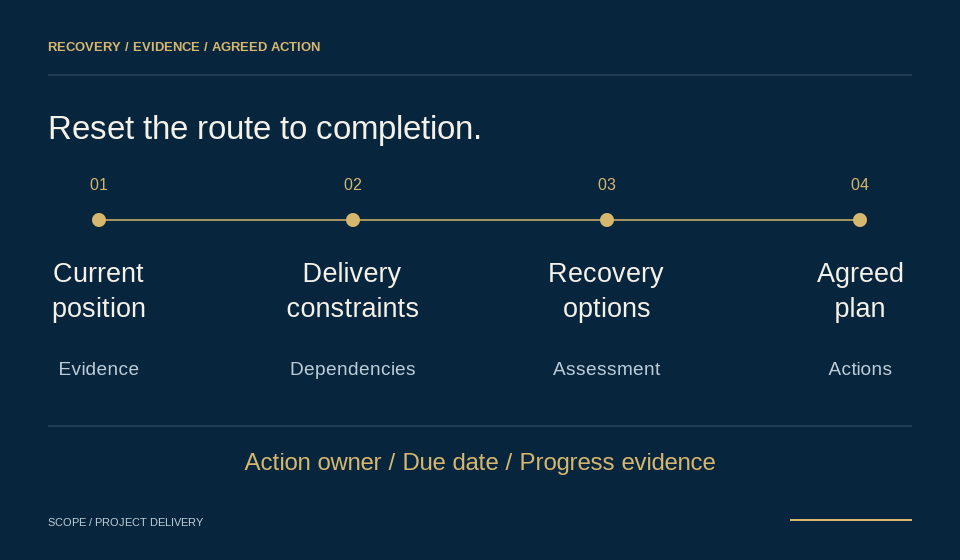
A project recovery review starts with the work remaining and the evidence available today.
Before agreeing a revised finish date, identify the causes of delay and the constraints affecting the delivery team.
The review needs to connect scope, programme, resources, commercial commitments and client decisions. A recovery plan should record what can change and what the options require.
1. Agree the review date and evidence
Set a common status date. Gather the current scope, programme, progress records, cost position and outstanding decisions.
Check how completion has been measured. An activity described as almost finished may still need testing, documentation or acceptance.
Walk through the remaining work with the relevant delivery parties. Confirm physical progress and the information needed for the next activities.
Record gaps in the evidence. Assign actions to verify them before a recovery assumption becomes a commitment.
Keep the original baseline and previous forecasts available for comparison.
2. Reconcile the remaining scope
Build a list of outstanding deliverables. Include approved changes, unresolved proposals, rework and completion documentation.
Identify work sitting between packages. Testing, reinstatement, interfaces and handover activities can be missing from the reported position.
Separate required scope from optional additions. The client needs to understand what each delivery option includes.
Confirm acceptance requirements and who can approve changes to them. Record any technical or contractual review needed.
Where scope remains uncertain, describe the assumption and its potential effect on time and cost.
3. Test the programme logic
Link the remaining activities to their predecessors. Include information release, procurement, access, approvals and commissioning requirements.
Check whether the forecast durations reflect current quantities and available resources. A date carried forward from the old programme needs a current basis.
Review the critical path and activities with little available float. Resource restrictions and access windows also need consideration.
For an illustrative refurbishment, finishing a room early may have limited effect if a long-lead component controls commissioning. Review the whole route to completion.
The resulting forecast should explain which assumptions determine the finish date.
4. Assess options with the delivery parties
Possible options include resequencing work, changing access arrangements, resolving information earlier or adding resources where feasible.
Test each option against space, supervision, quality, safety, productivity and supplier capacity. More people on site may create new constraints.
Agree what must happen before an option can start. Identify any design, commercial or statutory review required.
Show the expected time effect, additional cost and uncertainty. Where the original completion date is unrealistic, present the current evidence to the client.
A recovery review cannot guarantee that the original date or budget can be recovered.
5. Rebuild the cost forecast
Use the revised remaining scope and programme to review the expected final cost. Include outstanding commitments and uncommitted work.
Consider time-related costs and the resources required by each option. Record assumptions for unresolved changes and risks.
Keep the original budget visible. A revised forecast does not itself authorise extra expenditure.
Identify the client decisions needed to fund or change the proposed delivery arrangement. Follow the actual contract processes for instructions and changes.
Our cost control guide explains a non-overlapping forecast structure.
6. Turn the option into owned actions
The recovery action list needs one accountable owner for each commitment. State the required date and completion evidence.
| Action | Owner | Required evidence |
|---|---|---|
| Resolve a design query before procurement | Appointed design lead | Approved information issued to the relevant parties |
| Confirm a delivery slot | Named supplier representative | Written date and delivery requirements |
| Approve an access window | Client operations lead | Agreed access arrangement and constraints |
Add a specific required date to each action on your actual project. Set escalation routes for decisions outside the owner’s authority.
7. Review delivery against the recovery plan
Agree the recovery baseline and record the assumptions it relies on. Retain the original baseline for accountability.
Use a short look-ahead to check readiness. Review completed activities, new constraints and changes to the forecast.
Track whether recovery actions are removing the constraints they were intended to resolve. An action marked complete needs supporting evidence.
Report changes to the forecast date and cost with an explanation. Escalate decisions before their required dates wherever possible.
Use the agreed contract and governance processes throughout the review period.
Prepare for an independent delivery review
Provide the current programme, scope, cost report, contracts, progress evidence and known issues. Identify the people able to confirm the delivery position.
Define whether the appointment is a review only or includes ongoing coordination after the review. Agree outputs and attendance.
SCOPE’s project controls and recovery service covers programme reviews, cost forecasts and action planning.
Send a project enquiry with the current stage, forecast completion and immediate constraints.
Further reading
Discuss the support required for your project.
Project recovery and controls consultancy