
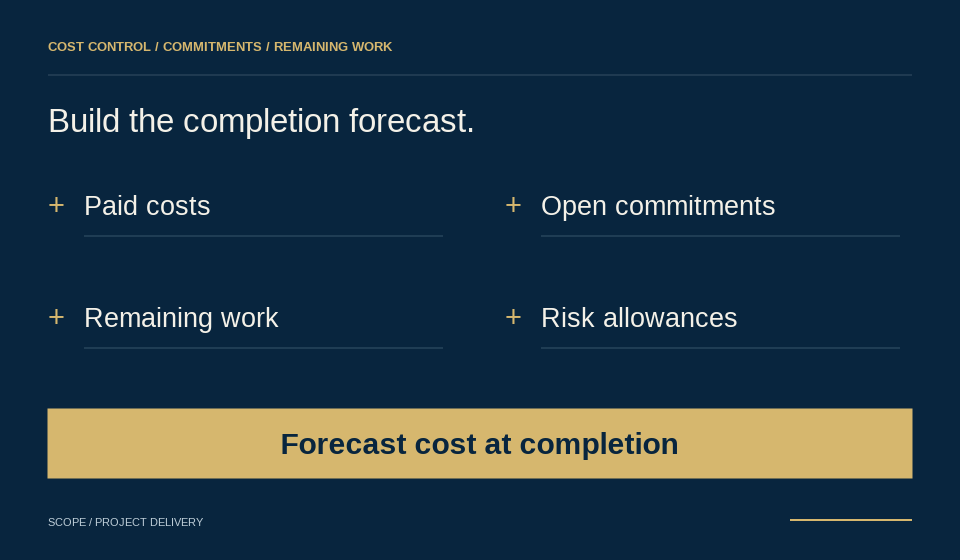
A project cost report needs to show what the remaining work is expected to cost.
The budget provides the agreed baseline. The forecast uses current information to estimate the final cost. Keep both visible during delivery reviews.
The method below suits a refurbishment, engineering installation or business project. Adapt the categories and detail to the project’s procurement and reporting arrangements.
Define the cost basis first
Record what the budget includes: contractor work, equipment, design, management, testing and client-supplied items.
Choose a consistent treatment of tax, inflation, financing and other applicable costs. State exclusions and seek appropriate accounting input where needed.
Give the budget a version and approval date. Record approved changes separately so reviewers can reconcile the current baseline with the original position.
Assign cost codes or work packages that match the procurement plan. The person reviewing the report needs to trace a total back to its source.
Separate costs into non-overlapping categories
A useful completion forecast distinguishes four categories:
- Actual cost: expenditure recorded to the reporting date.
- Outstanding commitments: the unpaid or unrecorded balance of agreed orders and contracts.
- Uncommitted remaining work: the estimated cost of required work without a current commitment.
- Additional allowances: identified uncertainty or anticipated changes not already included elsewhere.
Define these categories for your reporting system. A purchase order’s total value may include an amount already recorded as actual cost.
For a simple management forecast, add the four non-overlapping values. Reconcile the forecast with the cost ledger and order records.
Worked example: a £100,000 project
This is an illustrative example, not a SCOPE client result. All amounts use the same cost basis.
| Category | Amount | What the value represents |
|---|---|---|
| Approved budget | £100,000 | Agreed baseline |
| Actual cost | £28,000 | Expenditure recorded to date |
| Outstanding commitments | £42,000 | Remaining balance on agreed orders |
| Uncommitted work | £18,000 | Estimated remaining scope without orders |
| Additional allowances | £7,000 | Uncertainty not included in the other categories |
| Forecast final cost | £95,000 | £28,000 + £42,000 + £18,000 + £7,000 |
| Forecast headroom | £5,000 | £100,000 budget less £95,000 forecast |
The £5,000 headroom remains dependent on the assumptions. It is not automatically available for additional scope.
If a previously unknown £8,000 work package is confirmed, the forecast becomes £103,000. The client then needs a decision on scope, funding or delivery options.
Check for double counting and missing scope
Reconcile each order’s paid amount and outstanding balance. Make sure the forecast uses only the remaining commitment after actual costs.
Check whether a change allowance is already included in a contractor forecast. Count the same expected cost once.
Review the scope against the cost breakdown. Small items can be missed when responsibility sits between contractors.
Examples include temporary access, protection, lifting, testing, reinstatement and handover documentation. The relevant items depend on the project.
A cost total can look stable while an unpriced scope gap remains unresolved. Give each gap an estimate basis and an action owner.
Link changes to programme effects
A scope change can alter supervision, access, hire periods or other time-related costs. Review these effects alongside the direct work price.
Keep approved changes, pending proposals and possible risks distinguishable. Show the basis used in the current forecast.
Record who can approve a change and what supporting information is required. Follow the actual contract’s instruction and notice process.
Where the time effect remains uncertain, record the assumption and the date for resolving it. A project review should identify decisions requiring client action.
See our supplier and change management guide for a practical review structure.
Choose a review routine that matches the work
Set a reporting date and use the same date for programme and cost information where possible. Explain any timing differences.
At each review, compare the forecast with the previous version. Identify movements and the evidence behind them.
Review unresolved quotations, expiring assumptions and upcoming commitments. Record actions that could affect the forecast before the next report.
For a short refurbishment, a weekly review may suit active delivery. A longer project may need a monthly formal report with more frequent exception reviews.
Agree the frequency within the project controls appointment.
Present the decisions behind the numbers
A client review should leave a clear record of the expected final cost, its uncertainty and the decisions required.
Identify any funding decision, procurement approval or scope choice. Give each decision an owner and a required date.
Where the forecast exceeds the budget, assess options against the remaining scope and delivery requirements. Avoid assuming that an unexplained saving will close the gap.
If cost pressure accompanies programme delay, review both together. Our project recovery guide explains how to establish a current delivery position.
Contact SCOPE with the budget basis, forecast and current delivery stage to discuss support.
Further reading
Discuss the support required for your project.
Project controls and recovery support